Eyeliner for downturned eyes
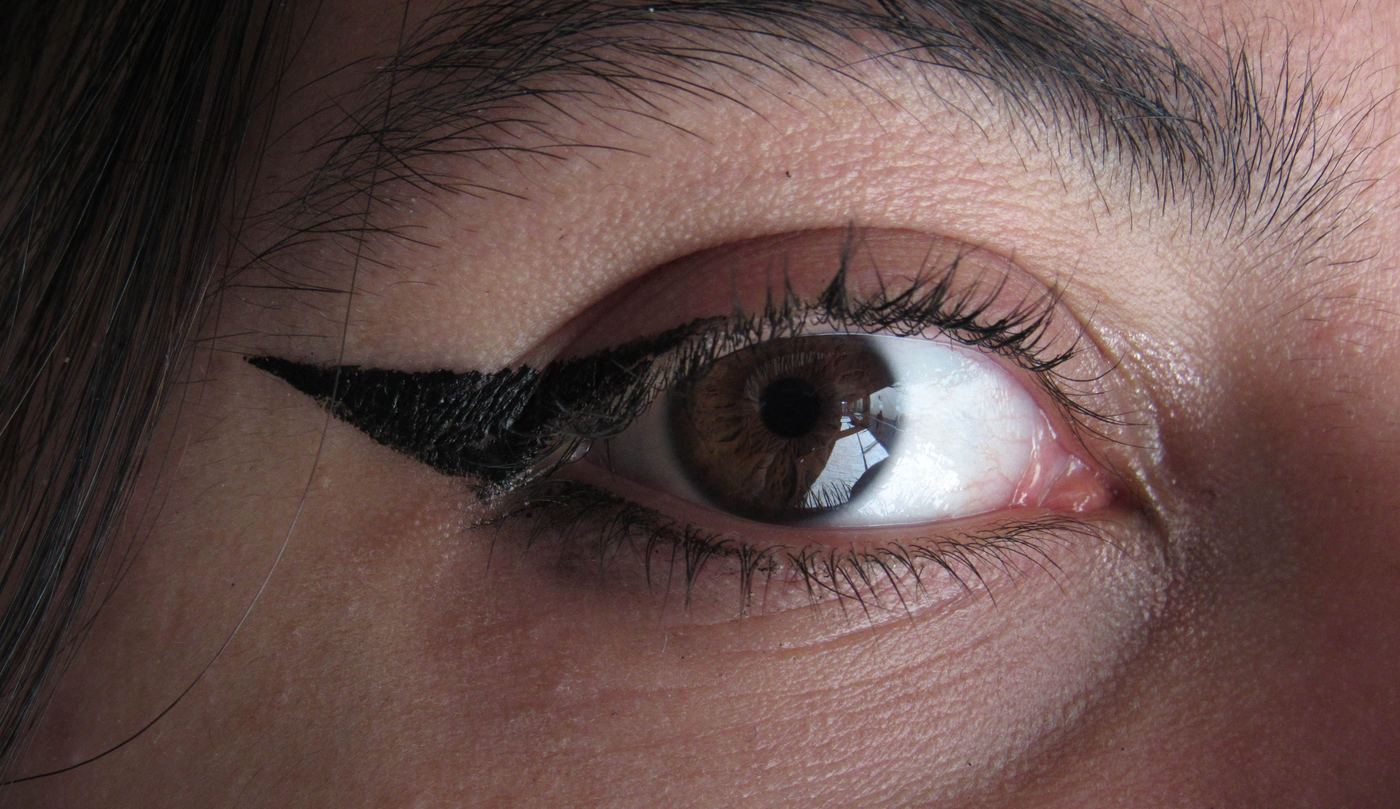
Downturned is geometry, not a flaw. Draw a straight line from the inner corner of the eye to the outer corner. On most eyes it runs level or tilts slightly upward. On a downturned eye it tilts down, because the outer corner sits lower than the inner one. That one fact decides where liner should go, and it is why the standard wing tutorial looks tired here rather than lifted.
The instinct is to compensate with more liner. The fix is the opposite: less line at the inner end, a flick that leaves the lash line early, and a lower lid that is mostly left alone. For the general method, read the winged eyeliner guide, then come back here for the adjustment. For the other shapes, start at eyeliner by eye shape.
On this page
What downturned actually means
Look straight ahead in a mirror, relaxed, and hold a pencil horizontally across the inner corner. If the outer corner sits below the pencil, the eye is downturned. It is the shape often called "droopy", which is the wrong word for most of these eyes: the corner is not drooping, it simply sits where it sits.
Two things follow. Anything drawn along the lash line inherits the downward direction, because the lash line itself heads down as it travels outward. And the outer corner has less lid space above it than the inner corner, so a line of even thickness looks thicker there. Both push the weight of the eye down and out.
Why the standard wing points down
The standard wing instruction, on our winged guide and almost everywhere else, is to continue the lower lash line past the outer corner. On a level eye that sends the flick upward at a pleasant angle. On a downturned eye the lower lash line reaches the corner on a flat or downward path, so continuing it sends the tail straight out or down. It ends below the level of the inner corner, and the whole eye reads as if it is sliding toward the cheek.
A full-thickness line from corner to corner makes it worse for a different reason. At the outer corner the lid is already short, so the same width of liner covers a larger share of the visible space and looks heavier at exactly the point that is lowest. Weight low and outward is the signature of the tired look, and it comes from where the liner is, not the eye.
The lifted wing, step by step
Start the flick before the corner, aim it at the tail of the brow, and keep the inner end of the line as thin as you can draw it.
- Map with two dots. Hold a pencil handle against the outer corner and angle it toward the tail of your brow. Put a dot where you want the flick to end, usually 4 to 6 mm out. Put a second dot on the lash line about a quarter of the way in from the corner. The shaky hands guide covers the dot method.
- Draw the tail first. Join the outer dot to the inner dot with one straight stroke. This line floats above the actual corner and does not touch it.
- Fill the wedge. Draw from the inner dot along the lash line to the corner, then fill the small triangle between that line and the tail. Keep it small. The lift comes from the angle, not the size.
- Thin the inner half. Run the thinnest line you can from the inner dot toward the inner corner, stopping a few millimetres short. Weight at the inner corner reads as a heavy, closed eye, the opposite of the lift you just built.
- Check with eyes open, straight ahead. The tail should end above the level of the inner corner. If it ends below, wipe it and raise the outer dot.
Downturned and hooded together
Downturned and hooded arrive together often. A hood is a fold of skin that covers part of the lid when the eye is open, and it usually sits lowest at the outer corner, exactly where the lifted wing needs to live.
The answer is to map the wing with the eye open, looking straight ahead, as the hooded eyes guide explains. Place the two dots with the eye open so the tail lands on skin you can see. When you close the eye to fill the wedge, the line will look wrong: broken, or too high on the closed lid. Ignore that. Open the eye and judge only what is visible.
Formula matters more here, because the fold rubs the line on every blink. A liner that sets fully holds where a soft kohl transfers into the crease. Our shortlist for hooded eyes was compiled with that in mind, and the smudging guide explains the transfer mechanism.
The lower lash line
This is where most downturned-eye liner goes wrong, and the fix is subtraction. A line along the outer third of the lower lid draws a second stroke under the lowest part of the eye and underlines the droop. Even a soft smudge does it. Leave the lower lid bare and let the lifted wing do the work.
One placement helps: a little pencil on the outer lower lash line, smudged upward into the base of the wing rather than outward along the lid. Done lightly it joins the bare corner to the floating tail, so the wing reads as part of the eye. Done heavily it becomes the underline you were avoiding. Skip the lower waterline too: dark there closes the eye, as the small eyes guide explains.
Puppy liner: the deliberate exception
Puppy liner is a flick drawn downward and outward from the outer corner, deliberately exaggerating a downturned tilt so the eye looks rounder and softer. It is a real technique, and it looks its best on exactly this eye shape, because the tilt is already there and the flick only leans into it.
So it is not a mistake. It is a choice. Puppy liner is drawn cleanly, kept short, and usually paired with a soft lower line in the same direction. The accidental version is a standard wing that happened to point down, with a heavy lower line fighting it. Decide which look you want before you pick up the pen.
What to buy
| Property | Why it matters here | What to avoid |
|---|---|---|
| Fine felt tip or small brush | The lift lives in a clean, narrow tail | Chubby tips and thick pencils on the upper lid, which turn the tail into a blob |
| Sets fully | The outer corner is where the lid and any hood rub most | Soft kohl on the upper lid unless you set it with powder |
The liner finder narrows the format in about a minute. If your lids have texture as well as a tilt, the mature eyelids guide explains why a pencil may beat a liquid for the thin inner half.
Questions people actually ask
What eyeliner is best for downturned eyes?
A fine-tipped liquid pen or a small brush with gel, because the lift comes from a clean, precise tail. With hooded lids as well, choose a formula that sets fully so the fold does not transfer it.
How do you do winged eyeliner on downturned eyes?
Start the flick before the outer corner, about a quarter of the way in along the lash line, and aim it at the tail of your brow so it floats above the corner. Keep the line thin at the inner end and check with eyes open that the tail ends above the level of the inner corner.
Should I put eyeliner on my bottom lid if I have downturned eyes?
Not on the outer third, which underlines the droop. Leave the lower lid bare, or add a little pencil at the outer corner and smudge it upward into the wing rather than outward along the lid.
Is puppy eyeliner for downturned eyes?
Yes. It exaggerates the downward tilt on purpose for a rounder, softer look, and it suits this shape better than any other. It is a choice, not a standard wing that accidentally points down.
What about downturned and hooded eyes together?
Map the wing with the eye open so the tail lands on visible skin, use a liner that sets, and judge only what shows when you look straight ahead.